Rooster Vector Clipart – 36 Designs: Graphics & Illustrations for Local Branding
As a brand designer who’s developed visual identities for over two dozen local businesses—from heritage coffee roasters and farm-to-table bakeries to handmade soap studios and seasonal candle boutiques—I approached Rooster Vector Clipart – 36 Designs not as clipart, but as a potential brand partner. My first real test? Refreshing the packaging and in-store signage for “Hen & Hearth,” a small-batch egg-based bakery in Portland that sources from nearby free-range farms. Their story is warm, grounded, and proudly rural—but not kitschy. So how did these 36 rooster illustrations hold up?
A Mood That Lands—Not Just a Motif
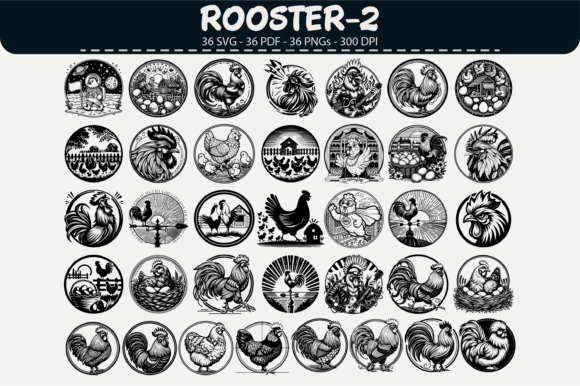
The collection leans into expressive, hand-drawn charm without sacrificing polish: think confident silhouettes with subtle texture, friendly side profiles with gentle line weight variation, and stylized poses that suggest liveliness—not cartoonishness. It reads as organic, approachable, and quietly confident. This isn’t clipart for novelty T-shirts; it’s a cohesive set of illustrations built for small business branding where authenticity matters. For food brands, farm shops, or artisanal makers, it signals craftsmanship and connection—not mass production. It feels equally at home on a kraft-paper soap label and a matte-finish candle sleeve.
Where Rooster Vector Clipart – 36 Designs Earns Its Place
In practice, this set became indispensable across Hen & Hearth’s rollout:
- Product labels: A simplified rooster head (SVG) anchored the front panel of their “Free-Range Frittata Mix” pouch—clean, scalable, and legible at 1.5 inches tall.
- Packaging accents: Used as a repeating border on thank-you cards and hang tags—subtle enough to support, not overwhelm, their serif + sans-serif typography pairing.
- Social media graphics: Layered over rustic photo backgrounds in Instagram carousels, the PNGs held crisp detail at 300 DPI—even when resized for Stories.
- Seasonal campaign visuals: One upright, crest-proud rooster became the hero graphic for their “Spring Harvest” limited-edition cookie box, printed on uncoated stock with spot UV on the beak for tactile emphasis.
- Printable inserts: Included in their wholesale kit as editable SVGs—so café partners could drop the rooster into their own menu designs without losing quality.
Real Business Value—Beyond Decoration
This isn’t about adding “a little flair.” When applied intentionally, Rooster Vector Clipart – 36 Designs strengthened several core pillars of professional branding:
- Stronger first impression: Shelf-ready packaging stood out among competitors using generic stock icons.
- Better product recognition: Customers began associating the specific rooster profile with Hen & Hearth’s values—free-range, local, human-scale.
- Clearer visual hierarchy: Using one consistent illustration style (not mixing vectors from three sources) unified their entire touchpoint ecosystem.
- Improved customer trust: Hand-drawn warmth signaled care—critical for food and personal care brands where safety and sincerity are non-negotiable.
- More polished marketing visuals: From Facebook ads to in-store posters, consistency elevated perceived quality without increasing print budgets.
Where to Lean In—and Where to Pause
These graphics shine brightest where personality supports function: product labels, packaging accents, hero banners, decorative brand elements, and social campaign assets. But context is everything.
Use carefully—or avoid—if your project demands:
- Formal corporate branding (e.g., law firms or financial advisors)
- Labels under 0.75 inches tall (test legibility early—some details soften at micro-scale)
- Crowded packaging layouts with dense ingredient lists or regulatory text
- Backgrounds with low contrast (check PNG transparency against light/dark substrates)
- Luxury minimalist brands where negative space and restraint define the voice
- Any layout where the rooster competes with essential information—like allergen statements or net weight
Brand Designer Notes You’ll Actually Use
Before committing to Rooster Vector Clipart – 36 Designs in client work, here’s what I tested—and recommend you do too:
- Mock it up for real: Drop an SVG into a physical packaging mockup (not just digital preview). Does it scale cleanly on textured paper or matte film?
- Check black-and-white use: Print a test sheet. Some line weights disappear or merge when converted to grayscale—especially fine feather details.
- Preview on small labels: Resize the PNG to actual label dimensions. Does the eye or beak stay readable?
- Test with your brand colors: Overlay the SVG on your primary palette swatches. Does it retain character—or get visually swallowed?
- Compare to competitor packaging: Is it distinctive enough to stand out on shelf or in an online grid?
- Verify print quality: Open SVGs in Illustrator—can you adjust stroke weight or simplify paths without breaking integrity?
- Inspect PNG transparency: Load into Photoshop. Are edges crisp? Any halo or anti-aliasing bleed on dark backgrounds?
- Test font pairings: Try the rooster beside serif, sans-serif, script, handwritten, and display fonts. Which combinations feel intentional—not accidental?
- Confirm commercial licensing: This is a digital product, and its license explicitly permits use in commercial design—including client work, physical product sales, and marketing visuals. Double-check before launching.
For local business owners, handmade sellers, and creative entrepreneurs building something real—not just another online store—Rooster Vector Clipart – 36 Designs delivers more than decoration. It’s a versatile, quality-controlled graphic design asset that helps translate story into sight, values into visuals, and craft into compelling brand identity. ✨ PLEASE READ BEFORE PURCHASE: This is a digital product. No physical items will be shipped. 📦 What’s included supports real-world execution—36 SVG files for infinite scalability, 36 high-res PNGs for pixel-perfect web and print use, and 36 PDFs for quick reference and sharing with printers or collaborators. When chosen with intention—and tested with rigor—it becomes part of the quiet professionalism that makes customers pause, remember, and return.