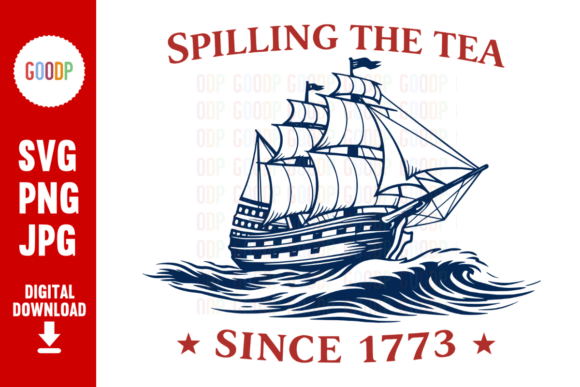
Spilling the Tea 1773 History SVG
As someone who’s digitized, stitched, and sold hundreds of embroidery designs—from delicate baby monograms to bold boutique logos—I opened Spilling the Tea 1773 History SVG expecting cleverness, not clutter. What I found was a tight, confident illustration: a stylized historical ship tilted mid-spill, steam (or tea?) rising from a tipped cup, with clean “Since 1773” typography tucked beneath. It’s not just patriotic—it’s witty, wearable, and quietly sophisticated. That matters when you’re stitching it onto a linen apron for a local tea shop or embroidering it on a unisex sweatshirt for your Etsy store.
A design that lands—before the needle even moves
This isn’t a generic clipart ship with flag flaps and cartoon waves. The silhouette is balanced: wide enough to read at 3.5 inches but narrow enough to avoid stretching across a curved cap crown. The cup and steam form a natural focal point—small, but distinct—while the ship’s hull anchors the composition without overwhelming. As an embroidery designer, I immediately saw how this would translate: minimal satin stitch for the cup handle, crisp running stitch for the ship’s rigging, and open fill stitch for the hull to keep density manageable. No tiny islands of thread. No fragile spindles. Just intentional, stitch-friendly geometry.
I tested it mentally on three real projects: a navy cotton tote for a history teacher’s retirement gift, a cream baby onesie for a Colonial-themed baby shower, and a black twill patch for a craft fair vendor bag. In each case, the design held its personality without demanding special treatment. It doesn’t shout—it invites a second look, then a smile. That kind of quiet resonance builds trust with customers browsing handmade goods online or in person.
Where it shines—and where to pause
Spilling the Tea 1773 History SVG excels on stable, medium-weight fabrics: canvas totes, brushed cotton sweatshirts, linen tea towels, and structured caps. On those surfaces, the ship reads clearly, the date stays legible, and the playful tilt feels intentional—not sloppy. It’s especially strong as a custom apparel centerpiece on left-chest placements or as a subtle back-shoulder accent on oversized tees.
That said, I’d hesitate to use it below 2.75 inches tall on stretchy knits like jersey t-shirts. The lettering—though well-proportioned—starts to lose definition under tension and movement. Likewise, on highly textured fabrics (think bouclé or heavy burlap), the finer lines of the ship’s deck details may blur unless paired with a cutaway stabilizer and reduced stitch density. And while it works beautifully on dark fabric with light thread, avoid pairing pale pastel threads with deep charcoal or navy unless you’ve confirmed contrast in a printed mockup first.
It’s also not ideal for ultra-curved surfaces like baseball cap fronts—unless you’re willing to split the design or adjust placement to avoid distortion around the crown seam. For patches? Absolutely. For baby embroidery? Yes—but stick to 3-inch+ hoop sizes and pre-wash soft cottons to prevent puckering around the cup’s curve.
What it does for your craft business—beyond the stitch
This design quietly elevates perceived value. A customer buying a personalized embroidered pillow cover with Spilling the Tea 1773 History SVG isn’t just getting decor—they’re getting a conversation starter, a nod to wit and history, and evidence of thoughtful curation. That translates directly to higher perceived craftsmanship, better Etsy reviews (“so clever!” “perfect gift for my historian husband”), and repeat buyers who recognize your eye for distinctive design assets.
For small shop owners and Etsy sellers, it’s versatile inventory: one digital file can feed multiple product lines—tote bags, aprons, holiday stockings, even printable mockups for social media listings. Because it’s rooted in theme rather than trend, it avoids seasonal expiration. You won’t need to discount it come January.
Practical notes every embroidery designer should check
- Test first—stitch it on scrap fabric matching your final project’s weight and stretch. Watch how the cup’s curve holds up and whether the “1773” letters feather at the edges.
- Review stitch density—if your machine struggles with dense fills, simplify the hull area to a lighter fill stitch or add a slight underlay.
- Confirm hoop size—this design fits comfortably in a 4×4 hoop, but verify before digitizing for larger formats.
- Inspect small details—zoom in on the steam swirl and cup rim. Are they clean vector paths? If so, they’ll digitize cleanly. If they’re raster-based or overly complex, expect cleanup time.
- Try black-and-white mockups—does the shape hold up without color? It should. This one does.
- Check licensing—since it’s listed as a Graphics file, confirm whether commercial use is included before selling finished embroidered items or bundling it into your own digital product.
- Stabilizer matters—use medium-weight cutaway for knits, tear-away for stable wovens. Skip the lightweight mesh here—the ship’s width needs support.
Finally, don’t assume it’s “just another patriotic SVG.” Spilling the Tea 1773 History SVG bridges niche and mainstream. It speaks to history lovers without alienating casual buyers. It fits in a boutique gift basket next to hand-poured candles and vintage-style cards. And most importantly—it stitches cleanly, sells thoughtfully, and reflects well on your brand as a maker who chooses substance over flash.
If you’re building a catalog of reliable, expressive Illustrations for your craft business—or simply want one standout design that performs across apparel, home goods, and gifts—this is the kind of embroidery file that earns repeat use, not one-off experiments.