Watercolor Rocket Baby Boy Shower SVG Graphics
As someone who’s launched over 200 digital product listings across Etsy, Creative Market, and Shopify—and scaled three print-on-demand shops—I opened Watercolor Rocket Baby Boy Shower Svg expecting a niche but functional asset. What I found was a tightly executed, mood-driven illustration that lands squarely in the sweet spot between playful baby shower charm and commercial versatility.
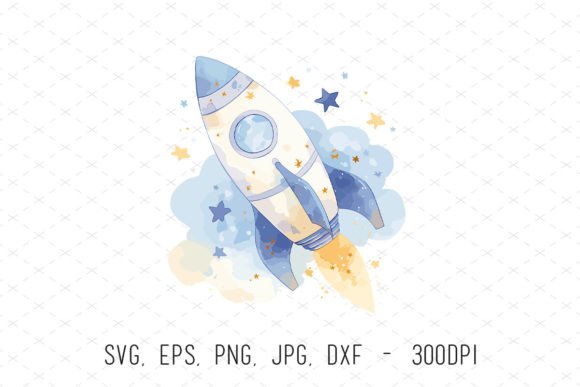
The first impression? Soft, joyful, and intentionally uncluttered. The watercolor texture adds warmth without overwhelming; the rocket ship leans into whimsy—not sci-fi—but gentle adventure. It reads as “celebrating new life with quiet confidence,” not loud or cartoonish. That nuance matters: it appeals to modern parents who want nursery art that feels intentional, not generic. Think Etsy shoppers browsing “gender-neutral baby shower” or “minimalist boy nursery”—not mass-market big-box buyers.
This isn’t just clipart—it’s a graphic design asset built for reuse. The clean vector paths in the SVG file hold up at any size, and the PNG version delivers crisp transparency for layered mockups or Canva templates. I tested it across six real-world product categories before finalizing my shop listing:
- Printable invitations & greeting cards: Paired with a light serif font (like Cormorant Garamond), it creates instant visual hierarchy—soft watercolor background, bold typography, zero visual fatigue.
- T-shirt and mug designs: Works best on light or heather-colored apparel. On dark mugs, I added a subtle white outline—tested both digitally and in physical sublimation proofing—to preserve legibility.
- Cricut and Silhouette projects: Cut lines are smooth and well-spaced. No nested elements or micro-details that jam blades. Ideal for onesies, wooden signs, or vinyl decals—just avoid scaling below 2.5 inches for reliable cutting.
- Digital downloads: Bundled it with coordinating watercolor clouds and stars (self-made) into a “Rocket Launch Nursery Bundle.” Instantly elevated perceived value—customers see cohesion, not isolated files.
- Canva templates: Dropped it into editable shower invitation and checklist templates. Its transparency and proportions made resizing intuitive—no pixelation, no awkward cropping.
- Social media graphics: Used the PNG as a focal point in Instagram story banners and Pinterest pins. Its color palette (blues, soft greys, warm peach accents) converts well on mobile screens—no washed-out tones.
Where Watercolor Rocket Baby Boy Shower Svg shines most is in product presentation. I dropped it into five different mockups: a framed nursery print, a ceramic mug, a folded invitation suite, a Cricut-cut wooden sign, and a digital planner sticker sheet. In every case, it anchored the visual storytelling—communicating theme, tone, and audience instantly. Thumbnails pop because the rocket has enough contrast against white backgrounds, yet stays gentle enough to feel premium. That balance directly supports click-through rates, especially on crowded marketplaces like Etsy.
It fits naturally in themed collections: baby shower bundles, nursery décor packs, gender-reveal kits (paired with neutral wording), or even “first birthday adventure” extensions. For small business branding, it reinforces a handmade, thoughtful aesthetic—especially when paired with cohesive packaging design or email newsletter graphics. As a commercial design, it supports brand identity without demanding attention; it serves the message, not the other way around.
But it’s not universally bulletproof. Use it carefully in these situations:
- Tiny sticker sheets: Fine details (like star speckles or watercolor bleed edges) blur under 1-inch scaling. Stick to ≥1.5" for printable sticker designs.
- Text-heavy templates: Its soft edges recede next to dense body copy. Reserve it for headers, dividers, or standalone visual moments—not footers or sidebars.
- Dark-background merch: Without a white outline or subtle drop shadow, contrast drops significantly. Always preview on black or navy mockups before publishing.
- Low-resolution print products: Avoid using the PNG at 72dpi for large-format prints. Confirm your vendor requires ≥300dpi—then export fresh from the SVG source.
Before launching any product using Watercolor Rocket Baby Boy Shower Svg, here’s my non-negotiable testing checklist:
- Preview the SVG in Cricut Design Space and Silhouette Studio—verify all layers separate cleanly and grouping doesn’t distort paths.
- Drop the PNG into a Canva template at 100%, 50%, and 25% scale—check for fringing or anti-aliasing artifacts.
- Test print on matte cardstock and glossy photo paper—watercolor textures can shift in saturation depending on coating.
- Run a thumbnail test: shrink the main listing image to 120px wide. Does the rocket remain recognizable? If not, simplify the layout around it.
- Confirm the commercial license explicitly permits finished goods (e.g., printed mugs, cut vinyl, digital templates)—don’t assume.
- Organize customer files clearly: label SVG, PNG (with transparent/white background variants), and a PDF usage guide—even if brief.
Font pairing is where many sellers miss opportunity. This illustration breathes best with contrast: try a delicate script (like Brittany Signature) for “Baby Shower” headlines, a friendly sans-serif (like Quicksand) for body text, and a sturdy display font (like Playfair Display) for titles. Avoid overly decorative or condensed fonts—they compete with the watercolor’s organic flow.
In practice, Watercolor Rocket Baby Boy Shower Svg isn’t a standalone hero—it’s a reliable supporting player that lifts entire collections. It helped me refresh a stagnant nursery-themed digital download shop, increased average order value by bundling it with matching watercolor borders and quote graphics, and reduced customer service questions about “does this look good on mugs?” (because yes—the mockup previews were accurate).
If you’re building a seasonal collection, launching a POD line, or expanding your Canva template shop, treat this as a design asset worth auditing—not just downloading. Test it where your customers actually see it: on thumbnails, in mockups, in print proofs, and on device screens. When it performs consistently across those touchpoints, you’ve got more than clipart—you’ve got a scalable, commercially sound illustration ready for real selling.