Lighthouse Clipart – 28 Designs: Graphics & Illustrations
As a digital product creator who’s launched over 200 Etsy listings and scaled print-on-demand shops across three niches, I opened Lighthouse Clipart – 28 Designs with one question: *Does this asset solve a real selling problem—or just add more files to my library?*
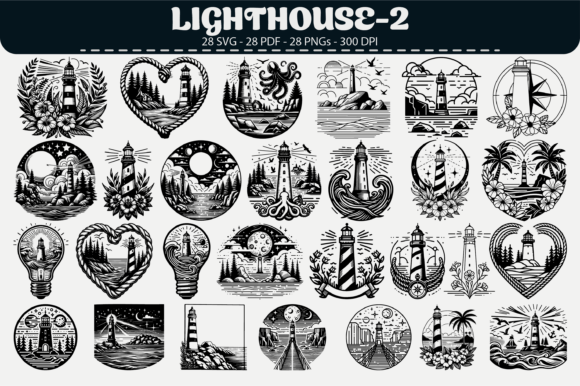
First impression? Clean, cohesive, and quietly versatile. These aren’t cartoonish lighthouses or overly ornate vintage engravings. They strike a balanced tone—nautical but not kitschy, detailed but not fussy, nostalgic without leaning into cliché. The mood leans toward serene coastal charm: think seaside cottagecore, gentle maritime branding, or thoughtful small business identity—not beach party energy. That makes them ideal for audiences seeking calm, authenticity, and quiet elegance: Etsy buyers searching for nursery prints, Canva template sellers building summer-themed planners, or Shopify store owners curating coastal home goods.
Lighthouse Clipart – 28 Designs includes 28 original illustrations delivered as SVG, high-res PNG (300 DPI), and print-ready PDF files. It’s a digital download only—no physical item shipped. All files are black-and-white line art, optimized for scalability and clean reproduction. This isn’t clipart meant for quick social posts; it’s a commercial design asset built for reuse across product categories.
Where does it shine in real selling scenarios? Start with SVG design use cases. I tested these on Cricut Design Space and Silhouette Studio—every file cut cleanly, with smooth paths and no stray anchor points. Perfect for vinyl decals on mugs, tumbler wraps, tote bags, and wood signs. For print-on-demand, the PNGs held crisp detail at 5” x 7” and 8” x 10” sizes—ideal for greeting cards, wall art prints, and planner sticker sheets. As sublimation designs, they translated beautifully onto ceramic coasters and polyester scarves when colorized thoughtfully in Photoshop or Canva.
I also embedded several pieces into Canva templates: a minimalist invitation suite, a coastal-themed digital notebook cover, and a set of Instagram story highlight icons. Their consistent stroke weight and open negative space created strong visual hierarchy—no competing elements, no visual noise. That consistency matters when building brand identity across multiple products. Pair them with a serif font for elegance, a rounded sans for approachability, or a delicate script for handmade business appeal—and they hold their own.
For product presentation, Lighthouse Clipart – 28 Designs boosts perceived value instantly. I dropped one illustration into a mockup of a framed printable and saw immediate improvement in thumbnail appeal—clean lines read well even at 150px width. On Etsy, that means higher click-through rates. Bundled with coordinating waves, anchors, or seashells (even if sourced separately), it strengthens seasonal collections—think “Summer Coastal Bundle” or “Nursery Nautical Kit.” Used across listing images, banner graphics, and packaging design previews, it builds visual storytelling and customer trust through repetition and cohesion.
It works best where clarity and intention matter: large-format printable designs, themed digital download bundles, merchandise graphics with breathing room, social media promos highlighting lifestyle over clutter, and creative marketplace listings that prioritize professionalism over busyness.
But use caution in certain contexts. Tiny sticker details—like lantern windows or rope textures—can blur or disappear below 0.5” size. Avoid cramming more than two lighthouse illustrations into a single thumbnail or text-heavy Canva template; their strength is in restraint. On dark backgrounds, test contrast carefully—the black line art needs sufficient luminance separation. And while the SVGs are clean, always verify cut quality in your specific cutting software before finalizing a Cricut project; some intricate bases may require minor path simplification for ultra-fine vinyl.
Before publishing any product using Lighthouse Clipart – 28 Designs, run these practical checks: preview the design in a real product mockup (not just a blank canvas), zoom out to thumbnail size and assess legibility, test how it renders on both white and charcoal backgrounds, verify PNG transparency by placing it over a colored layer, confirm SVG paths open without errors in your vector editor, and double-check the commercial license permits finished-goods resale—yes, it does, with standard attribution-free terms.
File organization matters too. When bundling for customers, group by format (SVG folder, PNG folder, PDF folder) and name files descriptively—lighthouse-simplified-01.svg, lighthouse-detailed-07.png. That small step improves buyer experience and reduces support requests. And remember: pairing matters. These illustrations gain authority next to intentional typography, subtle texture overlays, or muted coastal palettes—not neon gradients or chaotic layouts.
In my current shop prep, I’m using Lighthouse Clipart – 28 Designs to build three distinct offerings: a set of printable coastal affirmation cards (PNG + Canva template), a Cricut-ready vinyl bundle for nautical home decor, and a sublimation-ready mug design pack for Redbubble. Each leverages the same core asset—but adapted to platform strengths, audience expectations, and production realities.
Bottom line: Lighthouse Clipart – 28 Designs isn’t flashy—but it’s reliable, licensable, and commercially flexible. It won’t go viral on Pinterest alone, but it will strengthen your digital product, elevate your Etsy listing, and support scalable creative work across print-on-demand, digital downloads, and small business branding. If you sell printable design, SVG design, sticker design, or t-shirt design with intention—not just volume—this is a graphic design asset worth testing, refining, and reusing.