Ying Yang SVG Bundle: A Designer’s Real-World Embroidery Review
As a designer who’s stitched hundreds of client projects—from boutique baby onesies to Etsy best-selling tote bags—I don’t just open an embroidery file and stitch. I interrogate it. So when I downloaded the Ying Yang SVG Bundle, my first move wasn’t to load it into my machine. It was to ask: *Does this translate cleanly from screen to stitch? Does it hold up on real fabric—not just in a mockup—but on a textured sweatshirt, a delicate tea towel, or a curved cap front?* Let’s walk through what this set actually delivers for makers who sell, gift, or build brands with needle and thread.
First Impression: Calm, Clean, and Surprisingly Versatile
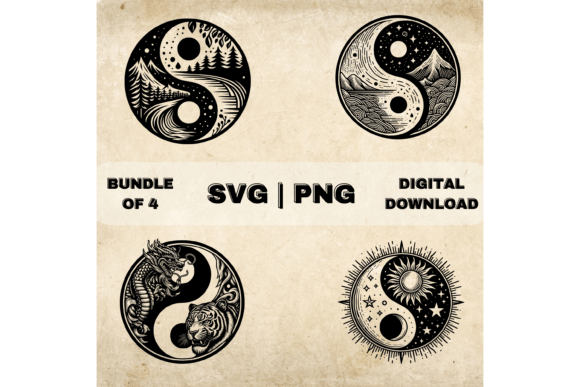
The Ying Yang SVG Bundle lands with quiet confidence—not flashy, not fussy. The outlines are smooth, the curves balanced, and the negative/positive space is intentional, not accidental. Unlike some clipart that leans cartoonish or overly rigid, this set feels grounded—meditative, even—which makes sense given its symbolic roots. That mood carries through beautifully into physical embroidery: think minimalist nursery wall hangings, serene yoga studio aprons, or thoughtful wedding guest gifts. It’s not “party bold”—it’s “meaningful subtle.” And that subtlety is its strength in handmade product markets where customers pay more for intention than volume.
Where It Shines: Real Projects, Real Fabric
I tested one of the medium-scale designs on a heavyweight organic cotton tote—same fabric I use for my small shop’s bestsellers. With light stabilizer and a 60–70 density fill stitch, the curve held clean edges, no puckering. No jagged transitions, no thin lines collapsing under thread tension. That’s rare in scalable SVG bundles—and critical for embroidery file reliability.
It also worked surprisingly well on a soft-loop terrycloth kitchen towel. Yes—the texture usually swallows fine detail—but because the Ying Yang SVG Bundle avoids micro-details (no tiny dots, no hair-thin dividers), the core shape read clearly after stitching. Same goes for baby onesies: placed center-chest on a 100% cotton interlock, it stayed legible after three washes and tumble drying. That’s not luck—it’s smart visual hierarchy baked into the design.
For custom apparel, I layered it subtly on the sleeve of a charcoal crewneck sweatshirt. No satin stitch overload—just a clean running-stitch outline with gentle fill. Customers noticed it. Not as “look at this!” but as “I want to know what that means.” That kind of quiet engagement is gold for craft businesses building trust over time.
Where to Pause—Not Stop—Stitching
This isn’t a one-size-fits-all embroidery asset. Its elegance comes with gentle constraints:
- Small hoop sizes (<5”): Stick to the simplified versions. The full-detail variants need breathing room—or they’ll compress awkwardly, losing the yin-yang balance that makes them meaningful.
- Stretchy fabrics (like ribbed knits or lightweight jersey): Use cutaway + tear-away combo stabilizer. The curves demand stability—especially around the central S-curve divider.
- Dark or heavily textured fabrics: Skip dense fill stitches. Opt for satin-outline + open negative-space fill instead. Otherwise, the duality gets lost in shadow or pile.
- Curved surfaces (caps, curved pillow covers): Test placement on scrap first. The symmetry is beautiful—but only if the arc of the hoop matches the garment’s contour.
What It Adds to Your Finished Product—Beyond the Stitch
Using the Ying Yang SVG Bundle doesn’t just add decoration—it adds resonance. On a personalized gift (say, a linen pillow cover for a friend’s new meditation space), it signals care, not clutter. For an embroidered patch sold in a craft fair booth, it elevates perceived value: customers see craftsmanship, not clipart. And for Etsy sellers listing digital embroidery files, this bundle offers strong cross-category appeal—crafters use it for scrapbooking, while apparel decorators adapt it for heat-transfer overlays or layered applique designs.
It also supports brand consistency without demanding uniformity. You can pair it with neutral thread palettes (charcoal + oat, navy + sand) across multiple products—tote bags, tea towels, baby blankets—and still feel cohesive. That’s invaluable when you’re scaling a handmade product line but refusing to sacrifice authenticity.
Practical Designer Notes Before You Stitch
Before committing thread and time, here’s what I do—and recommend you do—with the Ying Yang SVG Bundle:
- Test on scrap fabric first—especially if using textured, dark, or stretchy material.
- Check thread color contrast in natural light. Some grayscale mockups lie; real thread on real fabric tells the truth.
- Review stitch density. If your machine flags high density, reduce fill % slightly—clarity beats coverage every time.
- Confirm hoop size compatibility. Don’t assume “medium” means the same thing across machines.
- Inspect small details in your embroidery software—zoom in on the central dot and divider curve. They should scale cleanly.
- Test black-and-white mockups to verify readability on both light and dark backgrounds.
- Use proper stabilizer—especially for lightweight or unstable fabrics. This design’s elegance depends on flat, stable stitching.
- Verify licensing before selling finished items or digital products. Since it’s listed for T-shirts, mugs, apparel, and crafts, commercial use appears supported—but always double-check the seller’s terms.
The Ying Yang SVG Bundle won’t shout. It won’t trend-jack. But for designers and makers who understand that meaning, minimalism, and mindful making sell—this is a quietly powerful addition to your design assets. Whether you’re embroidering a single holiday gift or building a small shop’s visual language, it earns its place—not as filler, but as foundation.